Ventilation engineering
Building Ventilation Assessment
Independent building ventilation assessments for UK offices and workplaces — combining physical flow measurement, CO₂ verification and plant inspection to diagnose under-ventilation and the Sick Building Syndrome complaints it produces.
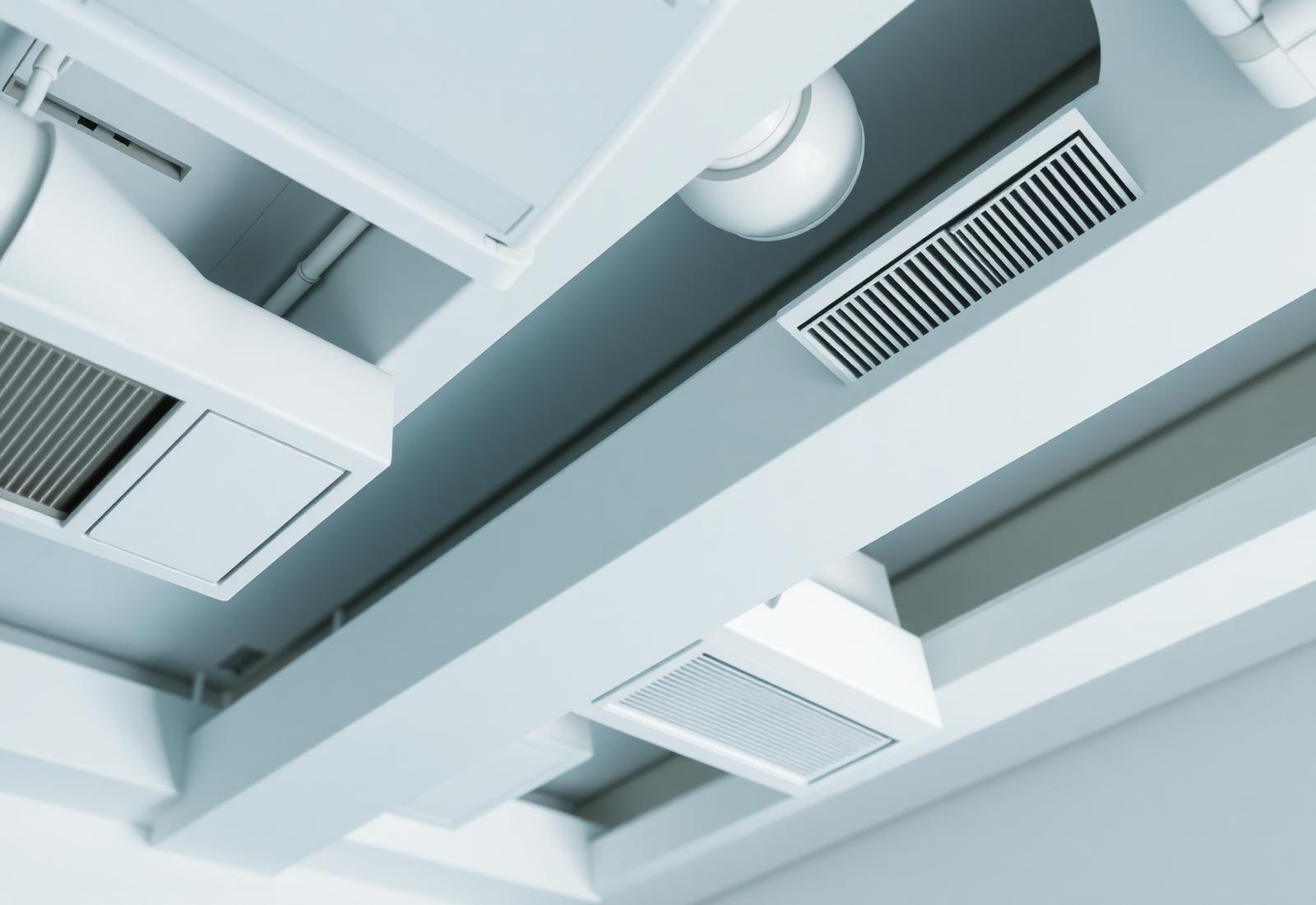
Why ventilation is the core diagnosis
Almost every Sick Building Syndrome cluster traces back to a ventilation shortfall
Under-ventilation is the most common, most under-diagnosed and most cost-effective-to-fix cause of workplace IAQ complaints. Once the fresh-air supply per person falls below the 10 L/s minimum required by Approved Document F, every other indoor pollutant — CO₂, VOCs, particulates, bioaerosols — begins to accumulate. Occupants report stuffiness, headaches, fatigue and reduced concentration. The pattern is the textbook Sick Building Syndrome cluster, and it has the same cause in 70%+ of cases we investigate.
Yet ventilation rate is rarely measured after handover. AHUs drift out of balance, filters load up and reduce flow, dampers stick, fan speeds get adjusted for energy targets. A building commissioned at 12 L/s per person can deliver 5 L/s ten years later without anyone noticing — until the complaints arrive.
A building ventilation assessment quantifies what the building is actually delivering today, against what it should be delivering under current standards. It is the engineering prerequisite for every credible remediation plan.
Methodology
Our ventilation assessment pathway
- 1
Stage 01
Documentation review
Original design brief, commissioning records, recent maintenance logs, BMS trend extracts, and any known modifications since handover.
- 2
Stage 02
Plant inspection
AHU walk-through: outdoor air intake position and damper authority, filter condition, heat-recovery effectiveness, fan condition, recirculation proportion.
- 3
Stage 03
Terminal flow measurement
Calibrated balometer or hot-wire anemometer readings at every supply and extract terminal in affected zones, totalled per zone and per person.
- 4
Stage 04
CO₂ verification
Independent verification using 5–10 days of continuous CO₂ monitoring at breathing-zone height, with steady-state and decay methods to confirm actual fresh-air rate per occupant.
- 5
Stage 05
Report & remediation
Written report against Approved Document F and BS EN 16798-1 Cat II, with ranked, costed remediation options and verification re-test specification.
Targets
Ventilation benchmarks for offices and workplaces
| Standard | Fresh-air rate per person | Notes |
|---|---|---|
| Approved Document F (statutory minimum) | 10 L/s | Building Regulations Part F |
| CIBSE Guide A | 10 L/s | Standard practice |
| BS EN 16798-1 Category II | 12.5 L/s | Design benchmark for new/refurb |
| BS EN 16798-1 Category I | 20 L/s | Best practice, sensitive occupants |
| WELL Building Standard | +30% over EN 16798-1 | Certification target |

Poor ventilation in office
The visible and invisible signs of poor office ventilation
Visible signs: condensation on windows in winter, occupants opening windows in mid-January, persistent kitchen or printer odours that don't dissipate, dust streaks around extract grilles, mould growth in cold-bridge corners. Less visible signs: a CO₂ trace that climbs above 1,000 ppm by 10am and stays there; a humidity trace that swings 20% over the working day; PM2.5 indoor/outdoor ratios above 0.7.
And the human signs: end-of-day fatigue, headaches that resolve at the weekend, mid-afternoon concentration loss, a complaint cluster mapped onto specific zones rather than the whole building. These are the patterns of poor ventilation in office settings, and they have engineering — not behavioural — solutions.
For every case where the assessment shows the building is delivering its design fresh-air rate and the complaints have another cause, we say so plainly. Honest engineering is what makes a ventilation assessment useful.
FAQ
Building ventilation assessment — common questions
Stuffy office? Complaint cluster?
Commission an independent building ventilation assessment. Call 01322 555566.
Request a ventilation assessmentRelated assessments
Investigate SBS