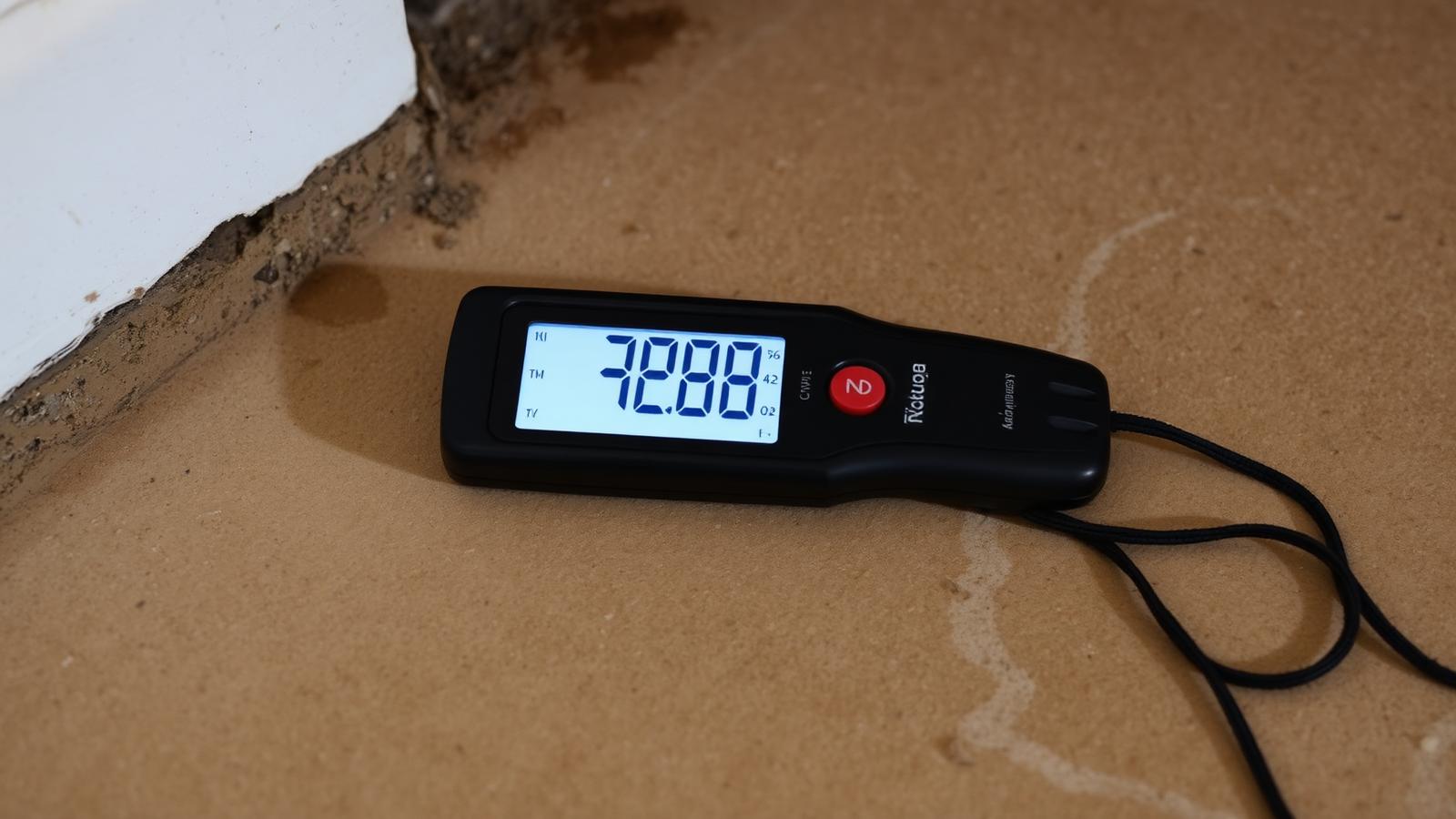
Radon is a colourless, odourless radioactive gas formed by the natural decay of uranium in soil and rock. It enters homes through cracks in solid floors, gaps around service pipes, suspended floor voids and construction joints. The South West, parts of the Midlands, North Yorkshire, North Wales and Northern Ireland have geology that produces the highest UK indoor radon. Public Health England (now UKHSA) attributes roughly 1,100 UK lung cancer deaths per year to indoor radon exposure.
01
What radon is and why it matters in UK homes
02
UKHSA Affected Areas
The UK Radon Atlas divides the country into 1 km grid squares. A square is an "Affected Area" when at least 1% of homes are estimated to exceed the 200 Bq/m³ Action Level. Affected Areas trigger BR 211 ('Radon: guidance on protective measures for new buildings') for new builds and a recommendation to test for existing homes. Search your postcode on the official UK Radon (UKradon) site to check your category before commissioning.
03
How the accurate test works
- Place one passive detector in a frequently occupied bedroom and one in the main living room (UKHSA two-detector protocol).
- Leave them undisturbed for 3 months — radon varies day-to-day and seasonally; only a long average is meaningful.
- Post the detectors back to the UKHSA-validated laboratory.
- You receive a written result with the annual average for each room, compared against the Action and Target Levels.
04
If the result is high — what to do
- Increase under-floor ventilation — clear airbricks, fit additional vents to a suspended timber floor. Often enough on its own for results 200–400 Bq/m³.
- Radon sump — a small chamber installed beneath the solid ground floor connected to a continuously running fan that vents radon outdoors. Highly effective for results above 400 Bq/m³ and typically reduces the level by 90% or more.
- Positive pressure ventilation — a loft-mounted fan pressurises the dwelling, preventing radon ingress. Suits homes where a sump is impractical.
- Re-test after installation — a 3-month re-test confirms the fix.
05
Background — UK pollutant reference
See our pillar page on radon in the UK for the science, the geology and the long-form policy history.
06
Frequently asked questions
Does my UK home need a radon test?
Use the UKHSA radon map (UK Radon Atlas). If your postcode falls within a 1 km grid square where ≥1% of homes exceed 200 Bq/m³ (an Affected Area), a test is recommended — and required for many ground-floor workplaces. Even outside Affected Areas, a 3-month detector is cheap insurance for ground-floor and below-ground rooms.
What is a safe radon level in the UK?
UKHSA sets an Action Level of 200 Bq/m³ — above this, remediation is recommended. A Target Level of 100 Bq/m³ is the level homeowners should aim for. There is no completely safe level; the lifetime lung cancer risk rises in proportion to exposure.
How long does a radon test take?
The accurate method is a 3-month passive detector placed in a bedroom and a living room, posted back to a UKHSA-validated laboratory. Short electronic tests give a 48-hour snapshot but radon varies daily and seasonally, so they are not reliable for action-level decisions.
What does it cost to test for radon in a UK home?
A UKHSA-validated 3-month two-detector kit (one per main living level) costs £45–£60 including lab analysis and a written report comparing your result against the Action and Target Levels.
If my radon is high, what's the fix?
Three remediation routes: (1) increase under-floor ventilation, (2) install a radon sump beneath the ground floor with a continuously running fan, (3) install positive pressure ventilation. Typical UK installation cost £900–£2,500; most homes drop below 100 Bq/m³ after treatment.